 Integritet
 PUBLIC ACCOUNTABILITY PLATFORM NATIONAL
The platform that shows who has actually done what for young people.
Institutions in Bosnia and Herzegovina have legal obligations towards young people. Every year Integritet asks each of them whether they are meeting those obligations, requires a document behind every answer, and publishes the score against the institution, its director and their party. We built it for the Institute for Youth Development KULT and have maintained it since 2022.
 Used by institutions at the municipal, cantonal, entity and state levels of government
 We did not start from nothing. We started from a platform the programme had long outgrown.
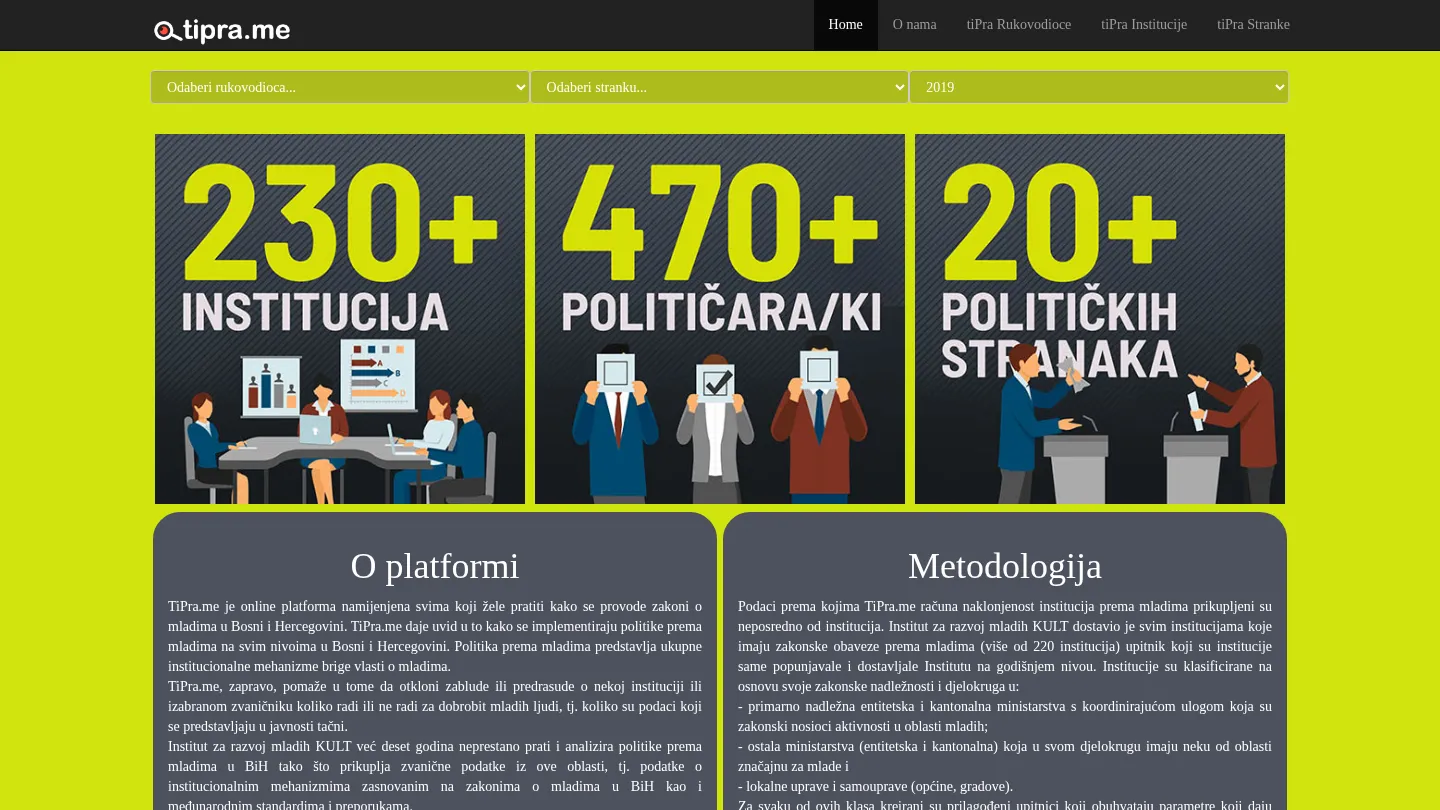
Integritet is older than we are. The programme has run since 2012, and from 2020 the platform lived at tipra.me. The mission was the same as it is today. Underneath, though, was a PHP monolith2 that had become more of a bottleneck every year. The interface was not intuitive enough, and a single report took long enough to run that you could make coffee while you waited.
Around that platform, an enormous amount of manual work was still going on. Questionnaires went out by email and by post, completed answers came back as Word documents, and the scoring was then entered by hand. Reminder rounds were tracked in notebooks.3
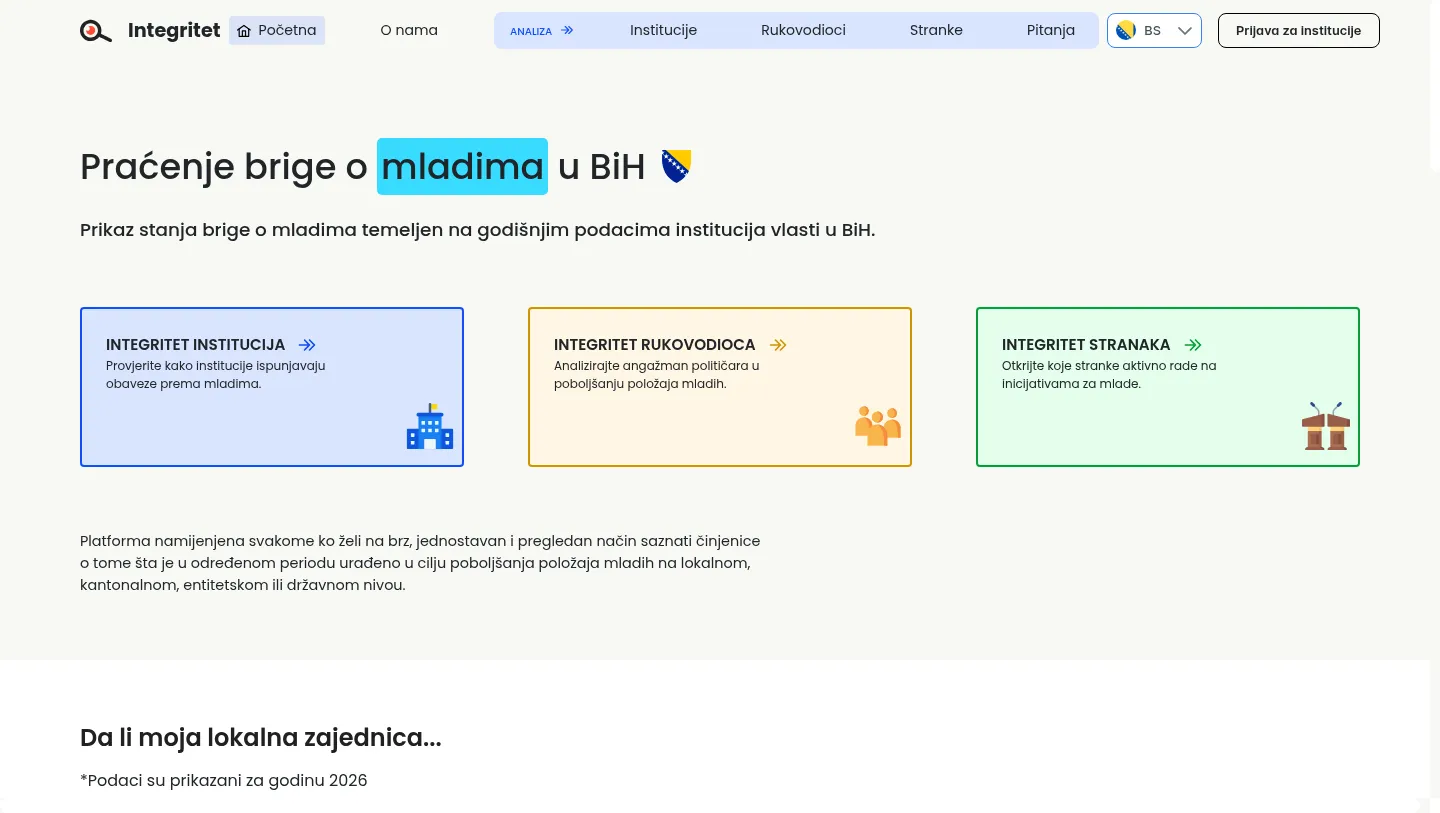
None of the data collected over a decade could be lost. The old records were migrated, so the same table today reads 2013 and 2026 alike.


The same page, two generations, and the step between them.
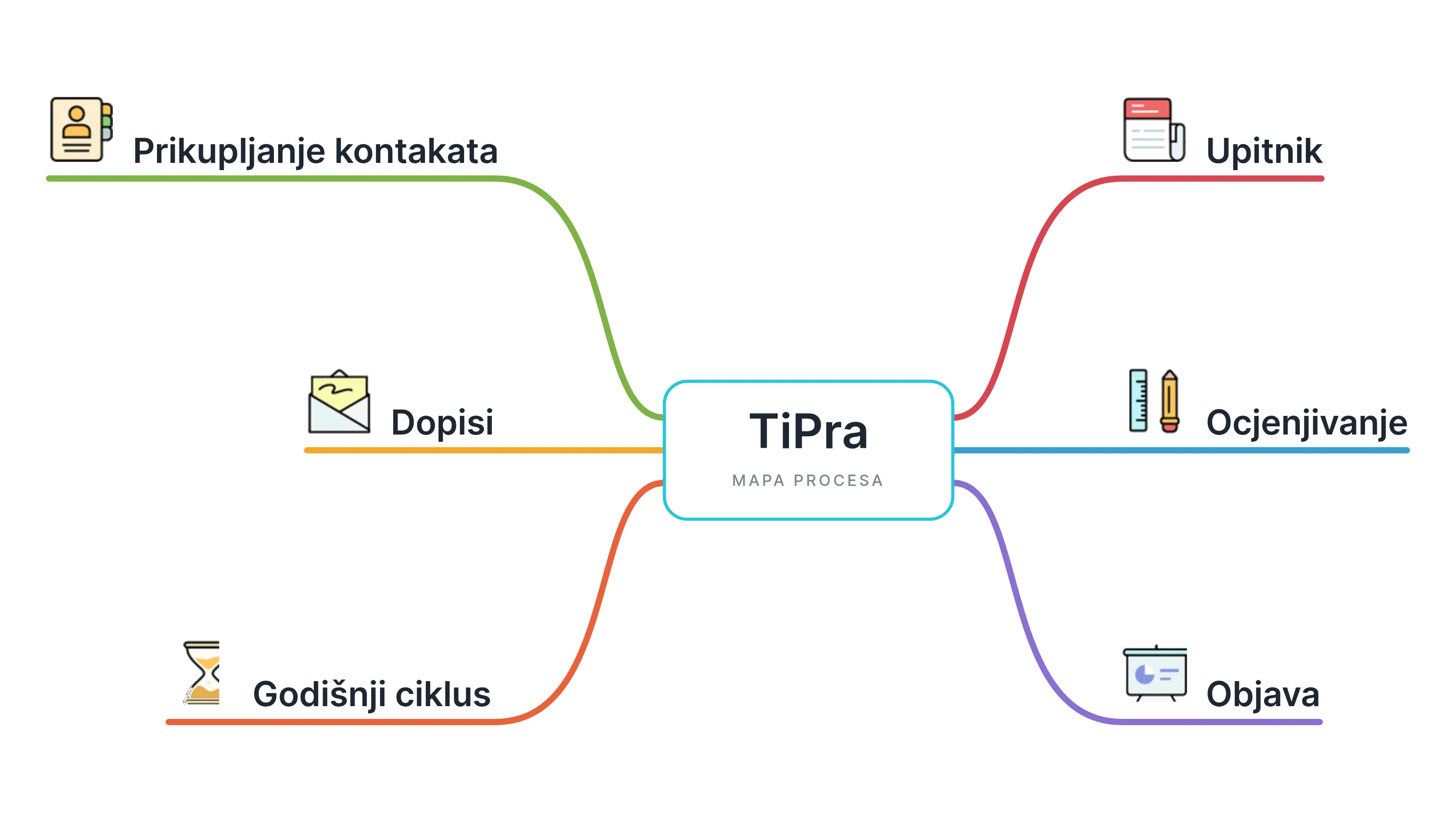
The inherited tipra.me and today's integritet.ba are two generations of one page. In the middle is the step that turned the first into the second, and that step was not code. Over the winter of 2022/2023, in interviews and workshops with the people who run the programme, we documented how contacts are gathered, how the official letter goes out, how a cycle runs and how scoring works. Out of that came the process maps and UML diagrams the new system was built from.
From a questionnaire to accountability at the ballot box.
01 / 06 The cycle
02 / 06 Notification
03 / 06 The questionnaire
04 / 06 No YES without proof
05 / 06 A score with a name
★ / 06 A tool for journalists
A cycle holds the year and the institution types it applies to, and is published from here.
Campaigns sent, the average score, who has answered and how many answers wait for review.
Composed from the template for that institution type, the letter goes out in bulk.
An institution signs in and sees its cycles: the open one waiting, the previous one closed.
An answer that carries points opens a place for the proof, and warns when it is missing.
Every group and every question shows the points earned out of the points available.
KULT reads the document behind every answer, then accepts it with its points or rejects it.
On integritet.ba the same question carries the same answer, the same points, the same document.
A director’s page holds every institution and year, the score per cycle and what is behind it.
All of it is public and needs no account: pick the institutions and the question to follow.
A question about money gets four answers side by side, each with the city’s coat of arms.
The same question across five cycles rises, falls, and from 2025 carries full points.
The screens are captures of the applications running on demonstration data. The questions, flows and rules are real; the scores, answers and amounts are not those of real institutions.6
One office does not use it. A whole sector does.
Integritet covers the work of youth institutions at every level of government, from the municipality to the state. Data going back to 2012 has been migrated, and questionnaires have now been completed through this system for a third year running.
THE PLATFORM, IN PUBLIC 7
 klix.ba 30 Dec 2013 How much have the authorities done for young people in BiH? “Integritet.ba currently records 230 institutions and their directors, along with over 500 documents submitted by government institutions” The launch announcement for the first version, nine years before we inherited it.
  mladi.org 24 Dec 2025 Transparency and integrity. Only 47 of 247 institutions responded to the questionnaire on implementing the youth law A non-response is not a hole in the data but a published result. The system counts it as a zero and shows it publicly.
  mreza-mira.net 23 Apr 2026 Who cares about young people, and can we prove it? A new cycle is open on Integritet.ba The call to institutions, carried further through the civil society network.
 TECHNOLOGY
Infrastructure that is not maintained by hand.
Every deploy brings the database into line by itself. Schema and data are updated as the application starts, with no manual steps. Nothing is configured by hand and nothing depends on one person.
SOURCES Where everything on this page comes from
1 FIGURES AND DURATION
240+ institutions, 400+ directors (listed on mladi.org as politicians) and 30+ parties, along with the tracking since 2012, are published at mladi.org/integritet, the programme page of the Institute for Youth Development KULT. The launch date of the first platform (30 Dec 2013) comes from the integritet.ba launch announcement on klix.ba.
2 THE OLD PLATFORM
The capture of the tipra.me home page is from web.archive.org. That it was a PHP application is visible from archived URLs of the form index.php?r=organizacijef/view and the yii.js files served with them.
3 THE MANUAL PROCESS
Our business process analysis, written for KULT between December 2022 and February 2023.
4 PHOTOGRAPHS
Portraits of our collaborators are from mladi.org, the Institute’s team page.
5 THE PROCESS MAP
A simplified version of the map from our analysis, the six processes it names, without the internal detail.
6 THE SCREENS
The applications in production, captured through real flows. The data on them is for demonstration. The poster on the cycle card is KULT's own campaign (“Mladi su srce Sarajeva”, the City of Sarajevo and KULT), shown here at its original resolution from mladi.org rather than the thumbnail the application carries.
7 COVERAGE OF THE PLATFORM
Klix (30 Dec 2013) reports the launch of the first version of the platform, the system we later replaced, not ours. The pieces from mladi.org and mreza-mira.net are the client's own announcements and their pick-up across the civil society network.
WHAT WE DO NOT CLAIM
The scores on the platform are not our findings. They are what institutions report about themselves and document.
Do you hold data that ought to be public?
We build systems where every published number has a document underneath it.
Built through our service Software Modernization.